A lot of buyers tell me the same thing: "I'll just wait for rates to come back down." It's a reasonable-sounding plan. But "waiting" isn't costless: it has a price, and that price is easy to calculate. Here's the math, plain and straight.
The rule of thumb worth memorizing
On a 30-year fixed loan, every half-point (0.50%) increase in your rate adds roughly $33 a month for every $100,000 you borrow. Finance $400,000 and a +0.50% move costs about $133 more per month. Finance $600,000 and it's about $199 more per month. The relationship scales almost exactly linearly with loan size, which makes it a useful mental shortcut any time you hear a rate headline.
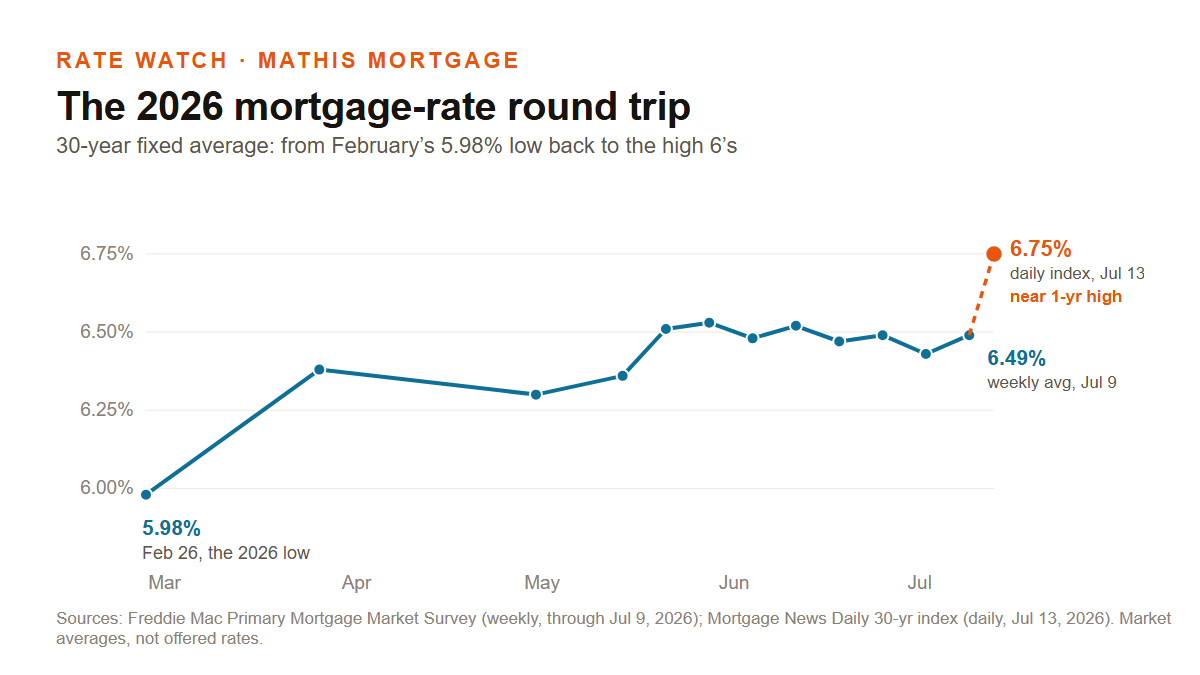
To put that move in context: the Freddie Mac weekly 30-year fixed average sat at 5.98% on Feb 26, 2026 (the first sub-6% reading in three and a half years) and had risen to 6.49% by Jul 9, 2026. The faster-moving Mortgage News Daily daily index was already at 6.75% on Jul 13, 2026. That's roughly three-quarters of a point of real, already-happened movement, not a hypothetical.
The full math, loan size by loan size
Here's what a +0.50% rate move costs on principal and interest, by loan amount. These figures are an illustrative example, not an offer or a rate/APR quote. Your actual rate and payment depend on your qualification and program terms.
| Loan amount | Extra / month | Extra / year | Extra / 30 years | Buying power lost |
|---|---|---|---|---|
| $400,000 | +$133 | +$1,595 | +$47,858 | –5.0% (~$20K) |
| $500,000 | +$166 | +$1,994 | +$59,822 | –5.0% (~$25K) |
| $600,000 | +$199 | +$2,393 | +$71,786 | –5.0% (~$30K) |
| $750,000 | +$249 | +$2,991 | +$89,733 | –5.0% (~$37.5K) |
These deltas hold up whether the move is from 6.0% to 6.5% or 6.5% to 7.0%: the dollar difference per half-point is nearly identical regardless of where the starting rate happens to sit.
The part most people miss: the double-hit
That table only covers the financing side of the equation. If home prices rise even a modest 3% while you're on the sidelines waiting for a better rate, a $500,000 home now costs about $15,000 more to buy, and, per the table above, roughly $166/month more to finance if rates also moved up half a point in that same window. You're not really choosing between "buy now" and "buy cheaper later." You're choosing between "buy now" and "maybe buy more expensive later, on a higher rate, if the market doesn't go your way."
Why this bet isn't a coin flip
Here's the part worth sitting with. Waiting isn't a symmetric bet where an equal-sized win offsets an equal-sized loss. It's lopsided:
- If rates fall after you buy, refinancing may be an option, subject to qualification. You keep the home you locked in on and get a shot at a better payment down the road.
- If rates rise while you wait, the payment you could have had is simply gone. There's no refinancing your way back to a rate that no longer exists, and a price increase can stack right on top of it.
One side of that bet has a plausible do-over. The other doesn't. That asymmetry (not a prediction about where rates go next) is the real argument for getting rate-ready now instead of waiting to see what happens.
For context on where the broader rate picture stands: futures markets are currently pricing meaningful odds of a Fed rate move at the next FOMC meeting, and forecasters like Fannie Mae and the Mortgage Bankers Association are not projecting a return to sub-6% rates any time soon. None of that is a guarantee of anything: it's simply the honest state of the data as of this writing.
Talk to Randy
If you want to stop guessing and see the actual number for your situation, let's run it together. Call or text me at (949) 990-6030 for a no-obligation rate-readiness check: no credit pull, no pressure, just the math that applies to your budget.