
A question I hear a lot: "Why did my rate quote go up when the Fed hasn't touched rates all year?" It's a fair question, and it deserves a real answer instead of a shrug. Here's the chain, start to finish, no hype.
The 90-second version
- Hot inflation makes bond investors demand a higher yield to lend long-term money: that yield is the 10-year Treasury.
- Your mortgage rate is basically the 10-year Treasury plus a spread. When the 10-year moves, your quote moves with it.
- The Fed's own June 2026 projections raised expected 2026 inflation from 2.7% to 3.6%. The 10-year Treasury and mortgage rates repriced accordingly, with zero Fed rate hikes.
The chain, link by link
It goes like this: inflation runs hot, so bond investors know inflation eats away at their fixed return, and they demand a higher yield to hold a 10-year Treasury. Mortgage lenders price the 30-year fixed off that same 10-year yield, plus a spread for mortgage-specific risk. That combined number is what lands in your quote.
The Fed's overnight rate (the one that makes headlines after every FOMC meeting) is a different lever entirely. That's why your mortgage rate can move a lot in a year the Fed never hikes at all.
What actually repriced this year
This isn't theory. It's exactly what happened in 2026. At its June 17 meeting, the Federal Reserve's own economic projections took expected 2026 inflation (PCE) from 2.7% in March up to 3.6% in June, and the Fed's statement said inflation "remains elevated relative to the Committee's 2 percent goal, in part reflecting supply shocks." That's the Fed itself saying, in its own words, that the inflation picture got worse: not a rate hike, a forecast revision.
The bond market didn't wait for a vote
Bond investors read that same inflation picture and repriced immediately, well ahead of any Fed action. The 10-year Treasury yield went from about 3.97% in late February 2026 to about 4.58% by mid-July. Mortgage rates followed the same shape: the 30-year fixed average (Freddie Mac's weekly survey) went from a 5.98% low in late February to 6.49% by July 9, and the faster-moving daily index (Mortgage News Daily) hit 6.75% by July 13.
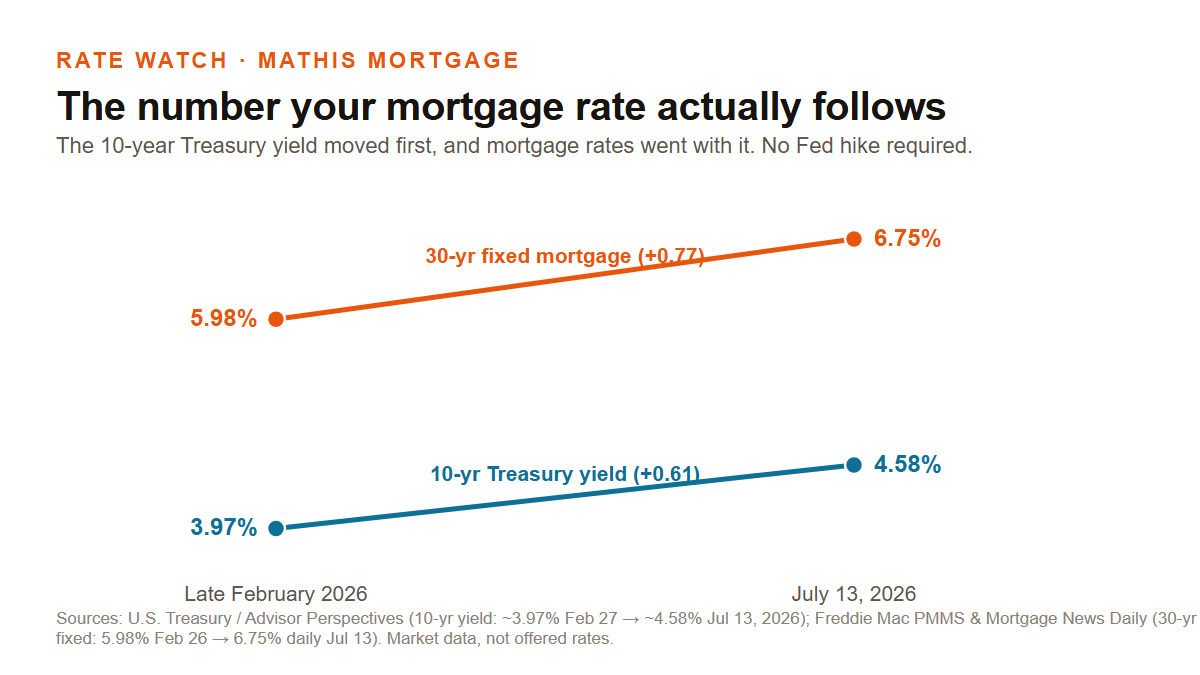
Notice what didn't move during that whole stretch: the Fed funds rate. Not once. Same slope, same direction, different scoreboard.
So what should you actually watch?
Not just the FOMC meeting calendar. The monthly inflation reports (CPI and PCE) are what move the 10-year Treasury (and your mortgage quote) between meetings, and sometimes they move it more than the meetings themselves. That's the honest, unglamorous truth: the number that matters most to your rate shows up on a routine government release schedule, not in a Fed press conference. It's exactly what I watch every morning, because it's the earliest signal of where rates are headed next, often weeks before the Fed says a word about it.
Talk to Randy
You don't need to track CPI releases yourself. That's my job, not yours. Call or text me at (949) 990-6030 and tell me the rate or payment number that works for your budget. I'll put you on watch and flag it the day the market gets there, in either direction (a no-obligation conversation, nothing more). If rates drop later, refinancing may be an option, subject to qualification. If they don't, at least you'll have made the call with your eyes open instead of on a guess.
Randy Mathis, NMLS #1516760 | DRE #02236644 Lumin Lending, Inc., NMLS #2716106 | DRE #02291443 Equal Housing Opportunity. Licensed in AL, AZ, CA, CO, ID, MD, MI, OR, PA, TN, TX, UT, WA.
This article is for informational purposes only and is not a commitment to lend or a rate/APR quote. Rates, yields, and forecasts cited are third-party market data and change daily; they are not offers of credit from Lumin Lending. All loans are subject to credit approval, income and property qualification, and program terms.
Data as of July 13, 2026. Sources: Federal Reserve June 17, 2026 FOMC statement and Summary of Economic Projections; Freddie Mac Primary Mortgage Market Survey; Mortgage News Daily 30-year index; U.S. Treasury 10-year yield.