
You get a HELOC or home equity loan by applying with a lender or a broker, who checks four things: your equity, your credit, your income, and your home's value. On the programs I have on file, you'll generally need a credit score of 600 to 680 or higher. You'll also need total home debt under the program's cap (85% of value at most lenders, up to 90% on some) and a debt-to-income ratio under 43% to 50%. After that come documents, a valuation, and closing. On a primary home, you also get a three-business-day right to cancel.
I'm Randy Mathis, NMLS# 1516760. I'm licensed in 15 states and work with 100+ lenders, and I shop HELOC and home equity loan programs across the ones that offer them.
A HELOC is a revolving line secured by your home. A home equity loan is a one-time lump sum. Both sit behind your first mortgage and leave it alone. My HELOC questions post covers how each one works after it's open.
How do I apply for a HELOC?
Seven steps, and on a digital program most of them take a matter of days.
- Estimate your equity. Start with a realistic value for your home, then subtract every loan secured by it.
- Know your credit tier. Your score decides which programs you fit and how much equity you can reach.
- Pick the product. Go with a HELOC if you'll draw over time, or a home equity loan if you need one known amount.
- Apply and read the disclosures. Under 12 CFR 1026.40(b), the lender has to give you its HELOC disclosures and the CFPB's HELOC booklet (or an equivalent one) with your application. If you apply through a broker, that happens within three business days.
- Send your documents. Income, mortgage statement, insurance, and ID (the list is below).
- Get the home valued. That's either an automated valuation model or an appraisal, depending on the program and the line size.
- Close, then wait out the right to cancel. On a primary home you can cancel "until midnight of the third business day," and under 12 CFR 1026.15 no money goes out until that window closes.
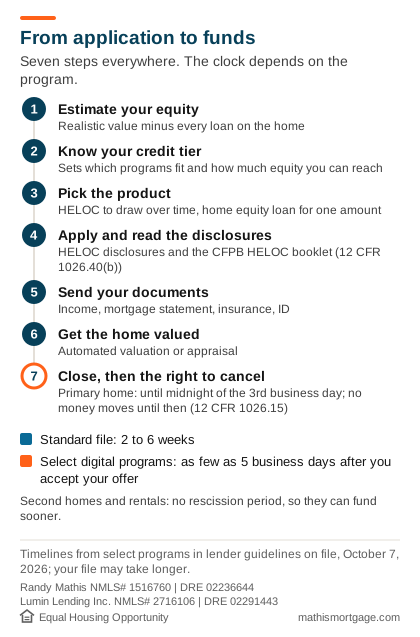
The steps are the same everywhere; on a primary home, the three-business-day right to cancel always comes before the money.
The CFPB's own HELOC booklet, the same one the lender hands you in step 4, gives you the advice straight: "Get three HELOC estimates."
How do I qualify for a HELOC?
Lenders look at four numbers: credit score, combined loan-to-value, debt-to-income, and how long you've owned the home. The ranges below cover the 13 HELOC programs in my lender guidelines on file as of October 7, 2026. They aren't one lender's terms.
| Requirement | Range across HELOC programs on file |
|---|---|
| Minimum credit score, primary home | 600 to 680; 640 and 680 are the most common |
| Minimum credit score, second home or rental | 620 to 700 |
| Maximum CLTV, primary home | 50% to 65% at a 600 score; at 680 and up, 75% to 85% at most lenders, 90% on some |
| Maximum debt-to-income | 43% to 50% on closed-end seconds; HELOC matrices publish no single cap |
| Time owned | No wait beyond a recorded deed at some; lower limits for the first 6 to 12 months at others |
| Line size | $25,000 minimum on most; $400,000 to $1,000,000 maximum on most |
Missing one program's limit doesn't end the search. Unless you fall outside every program in a row, a file that misses one program's limit can still fit another's.
Income still matters, even though the federal ability-to-repay rule doesn't cover HELOCs. 12 CFR 1026.43(a)(1) exempts "a home equity line of credit subject to § 1026.40," but every HELOC program I have on file still verifies income.
Texas works differently. Under Article XVI, Section 50(a)(6) of the Texas Constitution, a home equity loan or line can't push total debt on a homestead above 80% of fair market value. It also can't close before the 12th day after you apply or receive the required notice, whichever is later. So on a Texas file, the first thing to settle is whether the home is your homestead.
How much can I borrow with a HELOC?
Multiply your home's value by the program's CLTV cap, then subtract what you owe. Every dollar figure here is an illustrative example, not an offer or a rate/APR quote.
Say your home is worth $600,000 and you owe $350,000. At an 80% cap, $480,000 minus $350,000 leaves a $130,000 line. At 85%, it's $160,000. At 90%, on some programs, it's $190,000. At 60%, a common cap for a score between 600 and 619, it's $10,000. That's below the $25,000 minimum most programs set.
Same house, same mortgage, and the answer runs from no line at all to $190,000. Your credit tier moves that number more than anything else.
What credit score do I need for a HELOC?
600 at the low end of the programs I have on file, and 640 to 680 at most of them. From there, your score sets how much of your equity you can reach.
| Credit score | Maximum CLTV, primary home, across programs on file |
|---|---|
| 600 to 619 | 50% to 65% (three programs) |
| 620 to 639 | 55% to 70% |
| 640 to 659 | 65% to 80% on most |
| 660 to 679 | 70% to 85% on most |
| 680 and up | 75% to 85% at most lenders; 90% on some |
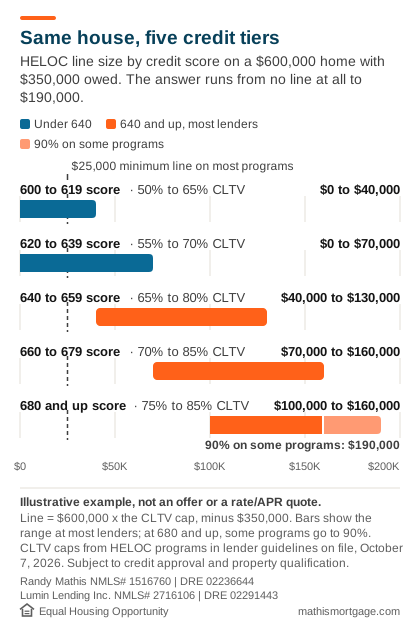
Same $600,000 home and $350,000 mortgage: the credit tier moves the line from $0 to $160,000 at most lenders, and to $190,000 on programs that go to 90%.
Each step up a tier tends to add 5 to 10 points of CLTV. On the $600,000 home above (an illustrative example, not an offer or a rate/APR quote), that's $30,000 to $60,000 more line. If you're close to the next tier, a few months of credit cleanup can be worth more than applying today.
What documents do I need for a HELOC?
Proof of income, your current mortgage statement, your insurance, and ID. Here's the usual list:
- Income, salaried: recent pay stubs and W-2s, or a payroll connection on digital programs.
- Income, self-employed: two years of tax returns on full-doc programs. Programs that offer other paths take 12 to 24 months of bank statements, a P&L, or 1099s.
- Mortgage statement: your current first-mortgage statement. One second-lien program on file wants it dated within 60 days.
- Insurance and HOA: your homeowners insurance declarations page, plus any HOA statement.
- ID: a government photo ID for each borrower.
Some programs skip the paper and verify income through a payroll or bank connection. One program on file takes only that kind of electronic verification, with no tax returns or P&L at all.
Is it hard to get a HELOC?
It's less about how hard it is than whether your file fits a program. With real equity, a 640-plus score, and income you can document, you clear the credit floor on 7 of the 13 HELOC programs on file, and the lender still reviews the whole file. It gets harder as any one of those thins out. Here's what most often stops a file, based on my lender guidelines:
- Not enough equity left after the line for your credit tier
- A score under 600, the lowest floor on any HELOC program on file
- A debt-to-income ratio over 43% to 50%
- The property type: manufactured homes, mobile homes, co-ops, condotels, mixed-use property and land are ineligible on every HELOC program on file
- Owning the home for less time than that program requires
A denial from one lender is just one lender's answer. I've taken a denied file back to the same lender, resubmitted it, and funded it. That won't happen on every file, but one "no" is worth a second look.
Do I need an appraisal for a HELOC?
Sometimes. On smaller lines especially, some HELOC programs value the home with an automated valuation model instead.
Federal banking rules allow that. Under 12 CFR 34.43, a national bank doesn't need a licensed appraisal on "a residential real estate transaction that has a transaction value of $400,000 or less"; it has to get "an appropriate evaluation" instead. My HELOC program page notes that many files use an automated valuation instead of an appraisal. At the other end, one closed-end second on file orders a full appraisal on every file.
Either way, the number that counts is the lender's value, so don't plan around an online estimate.
How long does it take to get a HELOC?
Two to six weeks on a standard file. On select digital programs, it can be as few as five business days after you accept your offer.
On a primary home, add the three-business-day right to cancel before funds move. Second homes and rentals don't have a rescission period, so they can fund sooner. My 5-day HELOC page shows that program, and the digital HELOC guide walks through it day by day.
Can I get a HELOC if I'm self-employed or my credit is under 620?
Self-employed borrowers have more than one path, depending on the program. Under 620 the line shrinks fast, and under 600 a home equity investment may be the better fit.
If you're self-employed, some second-lien programs on file qualify you on 12 or 24 months of bank statements, a P&L, or 1099s instead of tax returns. Others want two full years of returns, so picking the program matters.
Under 620, three programs on file start at 600, but they cap CLTV at 50% to 65%. On many homes, that leaves little or no line. Under 600, a home equity investment can consider credit scores from 500 on select programs, with no monthly payment. Here's the catch: it isn't a loan. The investor takes a share of your home's future value, and in a hot market that share can cost more than interest would. My HEI with a 500 credit score post runs the math. Availability by state changes often.
Should I get a HELOC from a bank, a credit union, or a broker?
A bank or credit union offers its own HELOC. A broker shops several lenders' HELOCs for you. The CFPB sums it up: "A broker does not lend money," and "You can use a broker to find different lenders or mortgage loans."
A credit union lends to its members, and a bank's answer reflects its own guidelines. Across the programs on file, credit floors run from 600 to 680. At the same score, CLTV caps can differ by 15 points or more between programs. That spread is the reason to shop.
FAQ
Can I get equity out of my home without refinancing? Yes. That's what a HELOC or home equity loan does. Both are second liens, so your first mortgage keeps its rate, balance, and payoff date.
Can I get a HELOC on a rental property? On some programs. Credit floors on file run 620 to 700 for rentals, CLTV caps are lower, and there's no rescission period. My HELOC on investment property post covers the details.
How soon after buying a house can I get a HELOC? It depends on the program. Some on file lend as soon as your deed records. Others cap how much you can borrow for the first 6 to 12 months.
Can I get a HELOC on a mobile home? Not on any open-end HELOC program I have on file. Manufactured and mobile homes are ineligible across all of them.
Start Your HELOC
Ready to apply? Start on my 5-day HELOC page. Want me to check your equity, credit tier, and income first? Call or text (949) 990-6030, or book a call. No obligation. Knowledge is power.